
Members at the Center: Highlights from the APTrust 2026 Fall Member Meeting
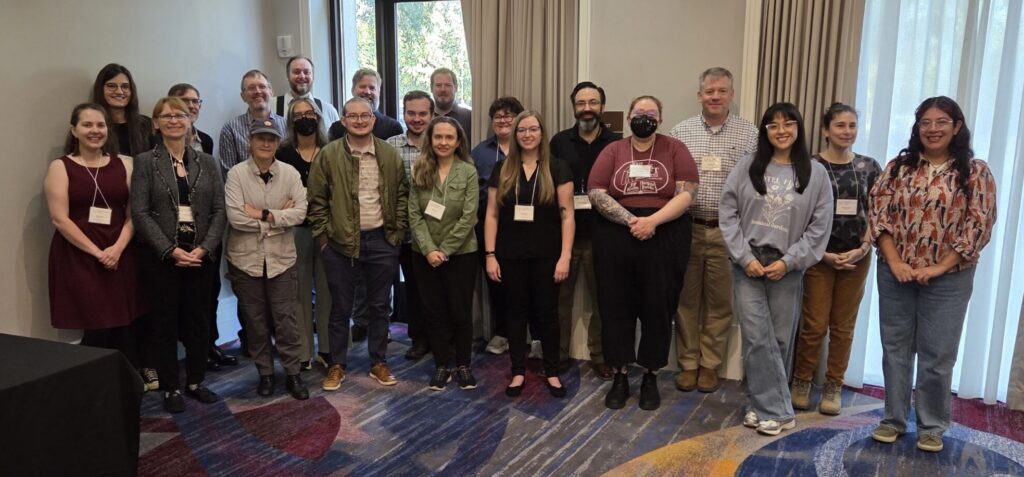
On October 15 and 16, APTrust members gathered in Atlanta and online for the 2026 Fall Member Meeting. The hybrid format brought practitioners from across the membership into one conversation, whether they joined in the room or on Zoom. As in past meetings, members themselves did much of the talking: more than a dozen institutions shared what they are building, what is working, and what is still hard.
The meeting opened with good news about the community’s growth. APTrust welcomed two new Sustaining members, the American Heritage Center at the University of Wyoming and Recollection Wisconsin, along with several new Associate members. As of October 1, 2026, members had deposited 806.1 TiB, a 27 percent increase over the prior year, with much of that growth coming from new members.
Governance continues to turn over in healthy ways. Paul Clough has been elected Advisory Committee co-chair and board liaison, while Alex Kinnaman rolls off after completing a term and continues as co-chair of the Certification Interest Group.
Lightning Talks: What Members Are Building
Two sessions of member lightning talks were once again a centerpiece of the meeting. Across institutions of very different sizes, a few themes stood out.
Backlogs are shrinking. Case Western Reserve University launched its digital preservation program in 2024 with a 140 TB backlog. After a year of focused work, that backlog is down to 16 percent of its original size, with more than 128 TB now preserved. Several other members, including the University of Arizona, reported clearing audiovisual backlogs or automating deposits of electronic theses and dissertations.
Preserving content held elsewhere. Princeton Theological Seminary has digitized more than 100,000 books, periodicals, and archival items through the Internet Archive since 2008, with few copies held locally. The seminary is now downloading that content, packaging it with DART, and depositing it in APTrust. More than 31,000 objects have been transferred so far, and every checksum comparison against the Internet Archive’s originals has matched. The team has offered to share its scripts.
Automation and integration. The University of Michigan now deposits automatically from its repositories, using APTrust for secondary copies. The University of Virginia built a submission tool connecting its institutional repository and digitization management system to APTrust, and now records preservation events in ArchivesSpace. Penn State is using the Open Journal Systems API to move journal content into APTrust via DART. Virginia Tech previewed a fixity and audit dashboard for its local digital repository, modeled on the APTrust Registry, set for release this month.
Legacy media and born-digital work. The University of Notre Dame recovered an experimental literature author’s 5.25-inch floppy disks using the open-source Greaseweazle (opens in new tab) tool, then created access copies through emulation. Case Western is piloting born-digital processing with its Special Collections, and Occidental College’s one-person digital program celebrated its first network-attached storage, affectionately named Fred.
New members, new models. The American Heritage Center is beginning to move roughly 95 TB of material into APTrust. Recollection Wisconsin described a statewide workflow in which contributors deposit material into a staging area, which is then bagged and uploaded to APTrust, and it plans to onboard public libraries and small historical societies next.
Open discussion ranged widely, from ADA Title II accessibility remediation to the surge in bot traffic that many repositories are seeing. Attendees pointed one another to COAR’s resource on dealing with bots (opens in new tab), a good example of the practical knowledge sharing these meetings make possible.
Candid Conversations Among Peers
Two sessions, both held under the Chatham House Rule, gave members space to talk frankly about the conditions behind their programs.
Propping Up the Stool took its name from the McGovern and Kenney’s three-legged stool of digital preservation (opens in new tab): organizational infrastructure, technology, and resources. Small groups traded challenges and creative solutions around funding, hiring, and equipment. Common threads included aligning decision-makers, working across organizational silos, and building productive relationships with campus IT.
The Only One Who Knows asked each participant to bring one process that only they understand. The conversation turned practical quickly. Participants stressed making sure colleagues know where documentation lives, asking others to test a written workflow, documenting procedures tied to specific equipment, and recording the reasoning behind a workflow, not just its steps. Several attendees noted that APTrust’s own public documentation helps with both transparency and findability, and some suggested a show-and-tell of documentation practices at a future meeting.
How Associate Memberships Actually Work
Associate membership lets a Sustaining member extend APTrust to a partner, often another unit on the same campus. A panel looked at the arrangement from both sides.
Daniel Cavanaugh described how the UVA Law Library, which is administratively separate from the University of Virginia Library, uses APTrust as a repository for born-digital content. Item-level bags are created through the ArchivesSpace API, and he called APTrust the best-value solution for the library’s needs. Sebastien Korner explained how Fulcrum, the University of Michigan’s publishing platform, deposits automatically and can now write a preservation commitment into client agreements and grants. Kara McClurken, speaking from the Sustaining member side at UVA, described how hosting Associates supports smaller and mid-sized partners.
The discussion that followed surfaced practical advice for any institution considering the model:
- Define roles and responsibilities up front; the Sustaining member is the first line of support for its Associates.
- Formalize the relationship in an MOU and build in a review cycle.
- Consider a sunset clause that addresses storage and costs if the relationship ends.
Several members, including the University of Notre Dame and William & Mary, have added Associates this year. Notre Dame credited the Associate Member Toolkit, with its checklist and sample MOU, with making the process straightforward.
Technical Updates, Shaped by Members
APTrust’s Lead Developer Melissa Iori and Lead Engineer for DevSecOps Flavia Ruffner shared progress on several fronts:
- Accessibility: The APTrust website and documentation platform now meet WCAG 2.2 Level AA, and work continues on the applications, including screen reader support, keyboard navigation, color contrast, and error handling.
- Automated Content Transfer: Members will soon be able to move entire objects between storage classes and locations in the Registry, with fixity verified after each move and redundant copies automatically cleaned up.
- Stronger sign-in: Authenticator apps are now an opt-in multi-factor option for the Registry, and institutional administrators can require them.
- DART 3.0.1: A maintenance release of DART and DART Runner brings bug fixes and accessibility improvements.
- DevSecOps: An eight-week evaluation of GitLab’s security tooling gave the team a clear plan for automated vulnerability and secrets scanning in its pipelines.
The Tech Discussion Space that followed was a two-way session, and members helped set the direction on three questions.
S3 encryption. The team walked through the history of encryption at APTrust. Members originally chose not to enable S3 encryption, prioritizing availability over the risk of lost keys, while Glacier storage has always been encrypted at rest. In January 2023, AWS began applying server-side encryption to all new S3 objects by default, leaving a mixed state. Because AWS manages these keys, the original concern no longer applies. The team laid out options for documenting or harmonizing that posture, an example of APTrust keeping its risk record aligned with technical reality.
File names. Members discussed whether APTrust’s guidance on POSIX-compliant file and folder names should be a requirement or a strong recommendation, given how widely other Unicode characters are used. The emerging consensus favored recommending POSIX conventions while continuing to test and accept broader character sets.
Canned reports. Mockups of new Registry reports, including storage and average file size by file format, annual storage cost, and an exportable access report for auditing, drew enthusiastic support. Members asked for CSV downloads, an API endpoint, and object-level reports.
DART Beyond APTrust: A LOCKSS Networks Panel
DART, APTrust’s free and open-source packaging tool, is increasingly used well beyond APTrust’s own membership. Executive Director Nathan Tallman moderated a panel with Chelsea Denault of the Michigan Digital Preservation Network, Kristi Park of the Texas Digital Library, and Danielle Taylor of GINKOnet, three LOCKSS-based networks building on DART for preservation deposits.
Panelists chose DART for the same reasons: it is easy to learn, adaptable to a distributed membership, and free to use, which matters most for under-resourced institutions. Each network is at a different stage. The Michigan network, which had no existing model to follow, wrote a pre-processing script that bridges DART’s push-based deposits with LOCKSS’s crawl-based ingest and adds virus scanning with ClamAV and format identification with DROID. The Texas Digital Library is making DART the primary ingest pathway as it transitions its preservation services, and GINKOnet’s members were already using DART in their own workflows.
Asked what would make DART sustainable for networks outside APTrust, panelists suggested a way for networks to contribute financially, a roadmap process open to non-members, a stronger user community, and a web-deployable version for institutions that cannot install desktop software. A web version of DART 3 is already on APTrust’s backlog, and the conversation gives APTrust a clear picture of what shared stewardship of a community tool could look like.
What’s Changing for Member Meetings
Members told APTrust that fall is a hard time to travel. The semester is busy, and the field’s conference calendar is crowded, with iPRES alone falling in October 2027. In response, APTrust is changing how it schedules member meetings, starting next year:
- The hybrid, in-person meeting moves to spring, when more members can travel.
- The fall meeting becomes fully virtual, keeping a second gathering each year without travel.
- In-person venues will alternate each year between a member library and a hub airport hotel, balancing the chance to see a member’s program up close with travel ease and cost.
The first in-person meeting under this model will take place in Spring 2027 at the University of Alabama at Birmingham (UAB).
Thank You
APTrust thanks every member who presented, facilitated, asked questions, and kept the Zoom chat lively, as well as the planning committee and session leads who made the hybrid format work. Recordings and slides for the recorded sessions are available to members.
Categories: Members