
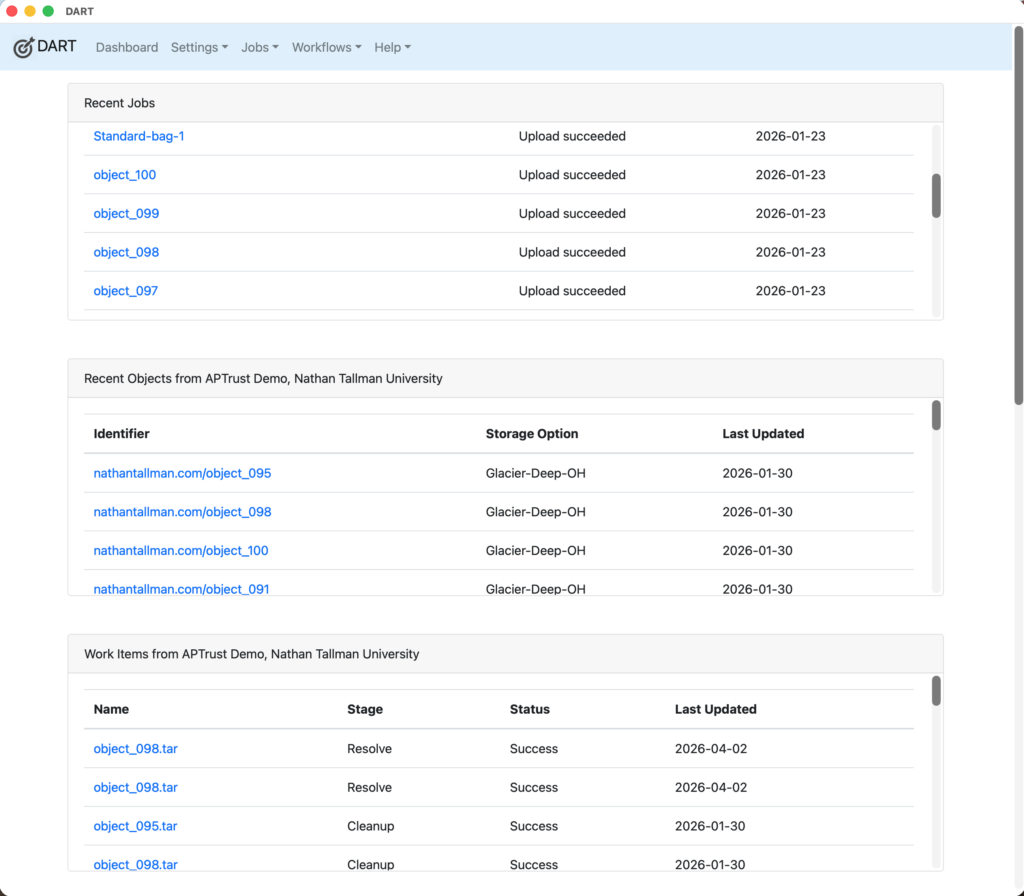
APTrust is pleased to announce the production release of DART 3, a major milestone for the Digital Archivist’s Resource Tool. This release marks the culmination of more than a year of alpha and beta development, and it brings substantial improvements in capability, reliability, and the day-to-day experience of packaging and uploading content for preservation.
DART 3 is a complete rewrite. Where DART 2 was built on Electron and JavaScript, DART 3 is written in Go and uses the Wails framework for its desktop interface. That change may be invisible to most users, but it has practical consequences: installation is simpler, the application performs better, and the codebase is positioned for long-term maintainability.
What’s New in DART 3
The most significant additions in DART 3 address workflows that users have long requested.
- Upload-only jobs allow users to upload previously created bags or files of any kind to remote S3 and SFTP servers without first packaging them. This is useful when content has already been bagged by another tool, or when uploading supporting files outside a standard preservation workflow.
- New output formats. DART 3 can now create, validate, and upload tarred gzipped bags (.tar.gz or .tgz), as well as loose bags that are neither tarred nor compressed. The expanded format support gives users more flexibility depending on their downstream repository requirements. NOTE: APTrust still does not support these formats for ingest.
- S3 download. Users can now browse configured S3 buckets and download files directly from within DART. Large file downloads are supported up to 50 TB.
- Artifact saving. The artifacts screen now allows users to save tag files, manifests, and other bag artifacts directly to disk, making it easier to retain records of packaging activity outside the bag itself.
- Settings import from DART 2. Users migrating from the previous version can carry over their configured storage services, BagIt profiles, and other settings without starting from scratch.
The 3.0 release also includes a number of quality-of-life improvements: storage service credentials now display as password fields rather than plain text (with an option to reveal), the APTrust Registry dashboard links open correctly in an external browser, and the application now handles very large bags (100,000 or more files) through bagging, validation, and upload without interruption.
Download DART 3
DART 3.0 is available for download now at aptrust.github.io/dart-docs/dart3/. Documentation for DART 3 is available at the same location.
DART 2 Is Now Deprecated
With DART 3.0 in production, DART 2 will not receive further updates. Users still running DART 2 are encouraged to migrate to DART 3. The settings import feature is designed to make that transition as smooth as possible.
A Note on DART’s Development Team
DART 3.0 is the last major release for which Andrew Diamond served as the primary developer. Andrew created DART and has been its lead maintainer since the beginning. He will be transitioning to a smaller role as Consulting Developer, contributing through code reviews and consultations. APTrust is grateful for Andrew’s work, which has made DART the tool it is today.
Melissa Iori, Lead Developer, contributed to the DART 3.0 release and will coordinate DART maintenance going forward. APTrust also welcomes open source contributions from the broader community. If you are interested in contributing, the DART repository is available on GitHub.
Stay Connected
APTrust maintains a DART user group for practitioners who use the tool in their work. The group is a place to ask questions, share workflows, and stay informed about future developments. If you are not already a member, you can sign up at aptrust.org/resources/user-groups/dart-user-group/.