
Neglect Has a Price Tag Too: Budgeting for Permanence
The year 2025 subjected academic and cultural heritage institutions to a level of funding uncertainty that few had planned for. Grants were terminated mid-stream. Federal agencies faced dismantlement. Overhead reimbursement rates that institutions had negotiated individually for years were threatened with a blanket cap. Some of those disruptions have since been reversed: IMLS reinstated all its grants following a federal court ruling in November 2025 (American Library Association, 2025), and the First Circuit Court of Appeals unanimously upheld the block on the National Institutes of Health’s proposed 15 percent indirect cost cap in January 2026 (Mervis, 2026). The immediate crisis eased. But the structural questions it exposed did not go away.
For digital preservation programs, 2025 was less a crisis in itself than a diagnostic. It revealed which parts of the preservation ecosystem were funded in ways that could survive a budget shock, and which were not. The lesson is not simply that institutions need more money for preservation. It is how preservation is funded that matters as much as how much is funded.
The cost of neglect is deferred, not avoided
There is an assumption in institutional budgeting that preservation is a cost that can be managed by reducing it during difficult periods and restoring it later. This assumption does not hold for digital preservation the way it might for other program areas.
Physical collections degrade slowly and visibly. A library that reduces its conservation budget for a year may incur some damage, but the damage is observable, its scope is bounded, and recovery is at least conceivable. Digital preservation failure works differently. Bit rot is silent. Format obsolescence accumulates without announcement. Unverified fixity records cannot be used to retroactively confirm integrity. A file that was valid five years ago may no longer be renderable today, and no amount of future investment will recover what was not preserved continuously.
Archival researchers have characterized this pattern as technical debt: the accumulated liability that results from deferring necessary digital maintenance and infrastructure work (Joyce et al., 2022). Like financial debt, technical debt accrues interest over time. A format migration deferred for a year is more costly than one addressed immediately. A fixity verification backlog grows with each cycle it goes unaddressed. And unlike most financial debt, technical debt in digital preservation may eventually become unrecoverable; some principal cannot be repaid regardless of the resources later directed at it.
The Preservation, Digital Technology & Culture editorial board, in a 2025 position paper documenting the scope of disinvestment across cultural heritage sectors globally, argued that wholesale cuts to cultural institutions represent a false economy that will cost far more to rebuild than to maintain (Trifunović, 2025). In digital preservation, that observation is not rhetorical. It describes a technical reality. A preservation program that is suspended and then reconstituted is not the same program. Content that was not continuously monitored, validated, and migrated during the gap has experienced real risk that cannot be retroactively removed. The cost of neglect is not eliminated by restoring a budget. It is simply realized later, at a higher cost, and often without full visibility into what was lost.
Where preservation costs stay hidden
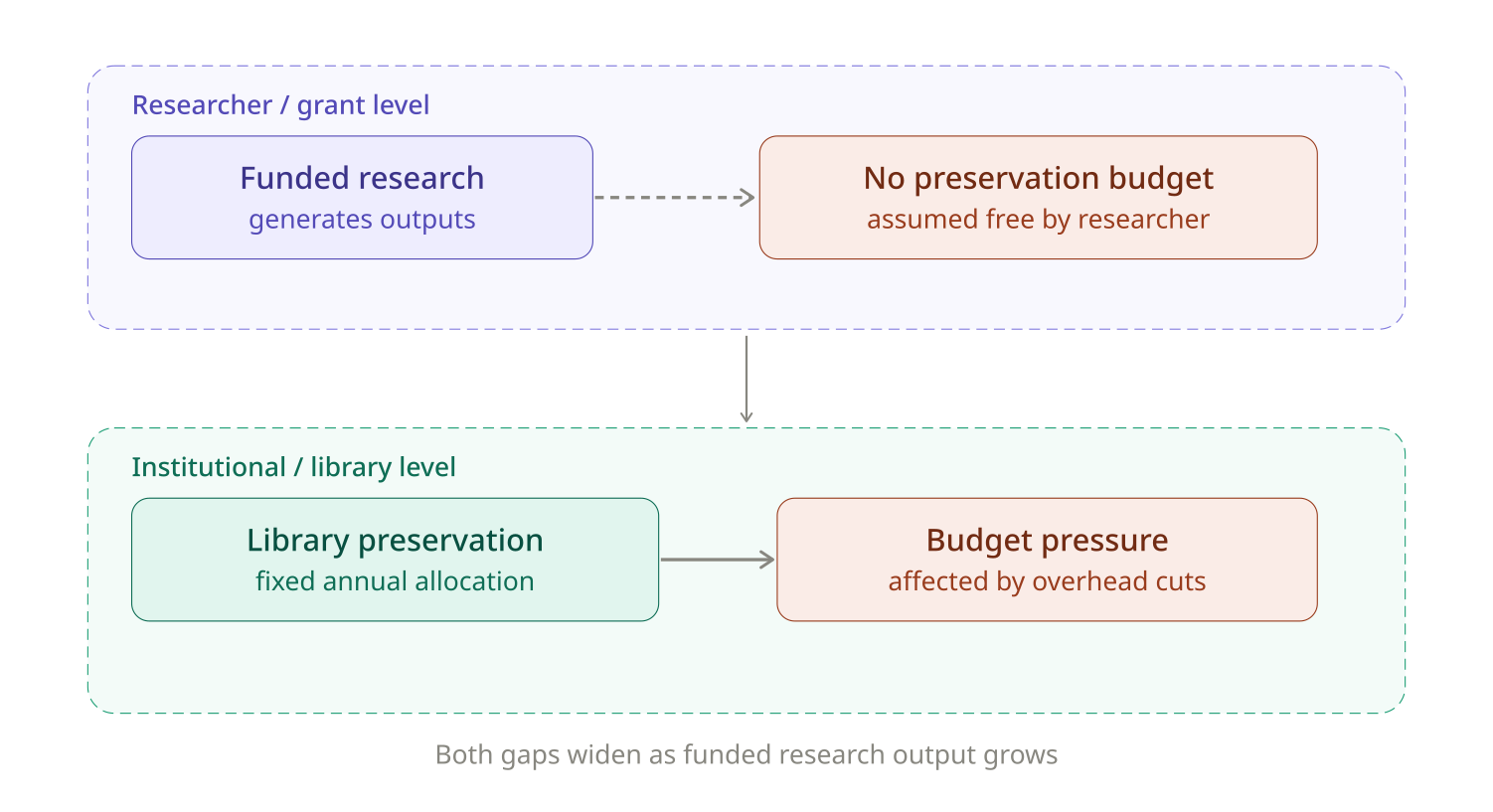
Preservation costs are invisible in two distinct places, and the gaps compound each other.
The first gap is at the researcher- and grant-level. Institutional library budgets typically do fund digital preservation as an explicit line item. But researchers who generate datasets, digital outputs, or born-digital materials that require long-term preservation often assume that retention is simply a free and general library service. A researcher who produces a 4 TB dataset with a seven-year retention requirement under federal data management policy may never budget for the storage costs of that commitment, assuming the library will absorb them. That assumption is not unreasonable from the researcher’s perspective, but it creates a structural mismatch: the library’s preservation budget is set institutionally rather than scaled to the volume of research output it is expected to cover. As funded research output grows and data management requirements tighten, the gap between what the library can absorb and what researchers implicitly expect widens.
The second gap is at the institutional level. The library budgets that do fund preservation depend on the broader institutional funding environment remaining stable. When that environment compresses, preservation is rarely the first thing cut, but it is rarely the first thing defended, either. The events of 2025 made this visible in acute form. Indirect costs, which cover administrative overhead and research facilities, constitute roughly one-third of the total size of a typical NIH research grant, with academic institutions negotiating those rates individually with the federal government (Mervis, 2026). When NIH moved to impose a flat 15 percent cap on all grants, institutions warned of dire impacts, with projected losses reaching into the hundreds of millions of dollars at major research universities (Unglesbee, 2026). A preservation program that exists as a line item in a library operating budget is one step removed from that pressure, but only one step.
Closing both gaps requires different but complementary responses: shared infrastructure that makes preservation survivable regardless of any one institution’s budget circumstances, and explicit grant-level budgeting that moves preservation costs to where the research obligation actually originates.
Shared infrastructure addresses institutional vulnerability
The first response to the institutional gap is community infrastructure. APTrust was founded on the premise that preservation capabilities that would be prohibitively expensive for any single institution to build and maintain can be made sustainable through a shared model. That premise has operational implications that matter in periods of budget pressure.
When preservation infrastructure is shared across a community of institutions, no single member’s budget crisis determines whether the infrastructure survives. The geographically distributed, replicated storage APTrust continues to operate regardless of what any individual institution is experiencing financially. That stability matters: an institution working through a constrained budget period is not managing a deteriorating preservation environment simultaneously. APTrust’s annual fee structure means institutions do need to sustain their membership to keep content preserved, but the shared model ensures that the infrastructure itself and the expertise behind it remain available and stable for members who do.
This is not a minor operational detail. The PDT&C position paper identified smaller institutions as particularly vulnerable to budget disruptions, noting the risk faced by those unable to adapt to drastic, abrupt changes in their ecosystems (Trifunović, 2025). Shared infrastructure is, in part, a structural response to exactly that vulnerability. A smaller institution that participates in APTrust has access to preservation capabilities it could not sustain on its own, and that access does not depend on its ability to weather every budget cycle independently.
This view is increasingly reflected in how library consortium leaders are thinking about their own strategies. A 2025 landscape scan of US-based library consortia conducted by Invest in Open Infrastructure found the sector at a critical juncture, with leaders recognizing that individual institutional survival depends on ecosystem-wide resilience (Lippincott et al., 2025). The report documented a growing consensus around a network-of-networks model, in which shared infrastructure and expertise distribute costs and risks more broadly than any single institution or program could manage alone. One consortium leader framed it plainly: there is simply no other way forward than sharing infrastructure and expertise, as resources of all kinds are stripped from institutions. The goal is a robust ecosystem in which the withdrawal of any individual component does not threaten the broader network’s stability.
Making preservation visible in research budgets
The second response addresses the grant-level gap directly. Jacob Nadal, Executive Director of the Center for Research Libraries, offered a pointed observation in the ORBIT landscape scan: even a core service like preservation needs to “anchor its value in the present” (Lippincott et al., 2025). That framing captures the challenge precisely. A preservation program whose costs are invisible at the grant level will always be at risk of being assumed rather than funded.
The most durable solution is to move preservation costs into the direct cost section of grant budgets, where they are explicit, documented, and defensible.
This is already permitted under federal grant guidelines for many funding agencies. Preservation of research data and digital outputs is a legitimate direct cost in funded research proposals, and funders increasingly expect institutions to demonstrate a plan for long-term access to the materials produced by their grants. The practical barrier has not been eligibility. It has been difficult to produce a specific, credible cost estimate when a proposal is written.
APTrust has developed a storage cost calculator (opens in new tab) to address that barrier directly. Available at calculator.aptrust.org (opens in new tab), it allows researchers and administrators to estimate the cost of preserving a specific volume of content over a specific duration, using APTrust’s transparent, publicly posted fee schedule. It supports both current pricing and the fee structure taking effect in April 2027, and covers APTrust’s three storage classes: High Assurance, Basic Archive, and Deep Archive. Estimates can be downloaded as a PDF formatted for inclusion in grant proposal budgets.
The calculator makes it straightforward to answer the question that grant proposals require: what will it cost to preserve the outputs of this research, and for how long? That specificity is what transforms preservation from an overhead assumption into a direct cost with a documented justification. A preservation commitment that appears as a line item in a proposal budget is visible to reviewers, defensible to auditors, and protected from the kinds of overhead reductions that 2025 made newly imaginable.
Scenario: 20 TB dataset · 7-year federal retention requirement · APTrust sustaining member
High Assurance
$460 / TB / year
$9,200
per year
$64,400
7-year total
Basic Archive
$110 / TB / year
$2,200
per year
$15,400
7-year total
Deep Archive
$80 / TB / year
$1,600
per year
$11,200
7-year total
Permanence requires structure, not just intent
The institutions and programs that came through 2025 with their preservation commitments intact were not necessarily better funded than those that did not. In many cases, they were better structured. Their preservation costs were explicit rather than embedded. Their preservation infrastructure was shared rather than siloed. Their content was held in systems designed to outlast any single institution’s fiscal circumstances.
The current environment does not make those structural decisions less urgent. In welcoming the IMLS reinstatement, ALA noted plainly that the fight is not finished: the administration can appeal court decisions, and Congress can choose not to fund IMLS in future years (American Library Association, 2025). The NIH indirect cost dispute similarly remains unresolved at the regulatory level, with the administration working on revisions to the underlying rules that would undergo formal rulemaking and apply to all federal agencies (Mervis, 2026). The disruptions of 2025 may have been reversed. The conditions that made them possible have not.
Digital preservation is not a program that rewards intermittent attention. The value of a preservation commitment is precisely its continuity: the fixity checks that happen on schedule, the format migrations that happen before obsolescence forecloses them, the replicated copies that exist regardless of what happens to any single storage environment. That continuity cannot be reconstructed after a gap. It can only be maintained.
Neglect has a price tag. It simply does not always arrive at a convenient time. Building preservation programs on shared infrastructure, and budgeting for them explicitly rather than embedding them in overhead that may or may not survive the next funding disruption, is not a matter of best practice alone. It is a matter of whether the content institutions are responsible for preserving will actually be there for the communities that depend on it.
References
American Library Association. (2025, December 3). ALA welcomes reinstatement of all federal IMLS grants to libraries. https://www.ala.org/news/2025/12/ala-welcomes-reinstatement-all-federal-imls-grants-libraries
Joyce, D., McPhee, L., Johnston, R., Corrin, J., & Hirsch, R. (2022). Toward a conceptual framework for technical debt in archives. The American Archivist, 85(1), 104–125. https://doi.org/10.17723/2327-9702-85.1.104
Lippincott, S., Skinner, K., Collister, L., & Wu, C. (2025). Open resilience: Building infrastructure together (ORBIT) landscape scan. Zenodo. https://doi.org/10.5281/zenodo.17193778
Mervis, J. (2026, January 6). Appeals court agrees that NIH cannot reduce overhead payments to academic institutions. Science. https://www.science.org/content/article/appeals-court-agrees-nih-cannot-reduce-overhead-payments-academic-institutions
Trifunović, B. (2025). PDT&C editorial board position paper on the emerging crisis in the cultural heritage and preservation sectors. Preservation, Digital Technology & Culture, 54(3), 255–258. https://doi.org/10.1515/pdtc-2025-0056
Unglesbee, B. (2026, January 6). NIH cap on indirect research costs struck down on appeal. Higher Ed Dive. https://www.highereddive.com/news/nih-indirect-cost-cap-appeal-struck-down/808925/
Categories: Thoughts